Download Dr. Trolley’s Problem on:
Steam (PC/Mac) Itch.io (PC/Mac*) App Store (iOS)
Dr. Trolley’s Problem is fully complete and at version 1.0. You can play this gam all about the trolley problem on almost all the important systems, with hopefully more to come. It’s the trolley problem game you’ve been waiting for!
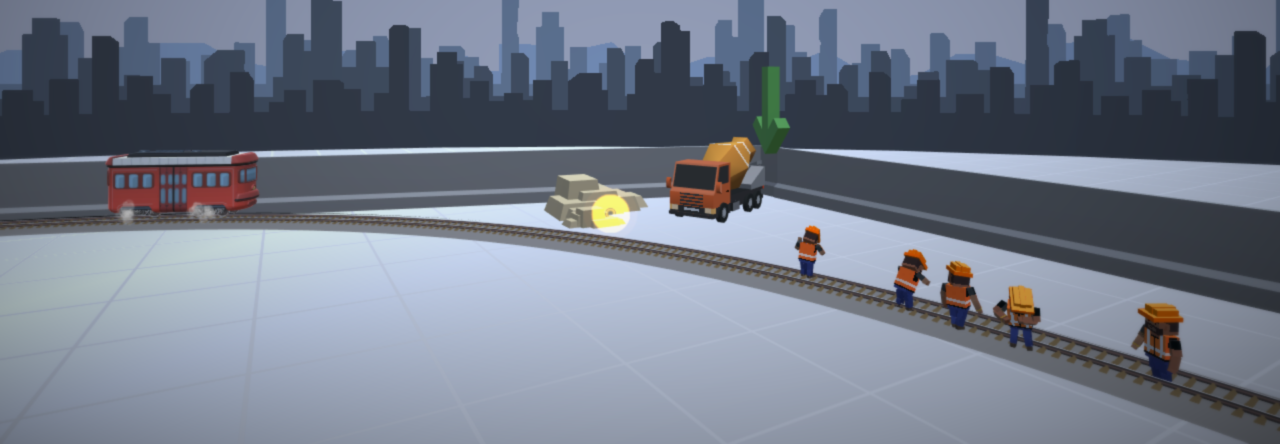
Dr. Trolley’s Problem brings the classic philosophical quandaries of The Trolley Problem to life and asks you to make life or death decisions on the fly. Explore your moral fibre in ways you never imagined (or asked for)!
Dr. Trolley is an infamous robot mad scientist from another dimension which has sequestered you in its simulation to answer the most pressing questions:
Should humans be allowed to drive cars? Or would driving (and most other things) be safer in the hands of Artificial Intelligence?
Successes

What we found during Early Access and almost a year of lackadaisical testing.
- The trolley problem situations spurred the conversations we hoped for.
- People want to be mobile, so the iOS version came from people asking for it.
- People enjoyed the chance-based situations after a series of serious ones. This was predictable since the inclusion of chance takes mental pressure off of the player.
- My code is like spaghetti, and yes, it’s far worse than VVVVVV‘s. I consider this point about code a success since my coding as improved to know how bad I was at it 😉
Next Steps
Promotion!
Basically we’re going to try to get it this game in front of as many people as possible. We’d love your help in that process! Tell your friends about the game and share as much as you can on social media.
Since a game is never actually done, we’re going to continue to fix bugs. I wish I could release things that are bug free, but that’s basically impossible for me 🙁
*the Itch.io Mac version is suffering from inability to correctly sign the app. Still working on it. The Steam version seems to work.

If we get enough sales (that’s to say quantifiable interest) we’ll do more:
- Add thematic situation packs. Situations take time to make and I only want to create more if I know they’ll be played. Thematic situations like political ones require custom art and that adds hard costs (not just time).
- Android version. I’ve tried and failed due to the bundle size, hopefully this will be released soon.
- Better, real time, statistics. I’ll admit the game is deceptive and I don’t like that as one of the goals from the get go was to share stats about player decisions. Implementing this turned out to be a nightmare and delayed us releasing the game by half a year. In summary, sending data to an analytics program is easy (ads track you everywhere and you really should get a tracker blocker), showing the collected data back to players is hard. I know that someone reading this is thinking “but that’s so easy and I do that all the time”; but, my coding skills are limited and my patience has run out dealing with multiple analytics services and their limitations.
You made it this far in the post so I know you care 🙂
Please show your love by sharing this post on your social network of choice.


You must be logged in to post a comment.